BANDANNA 'CROSS’
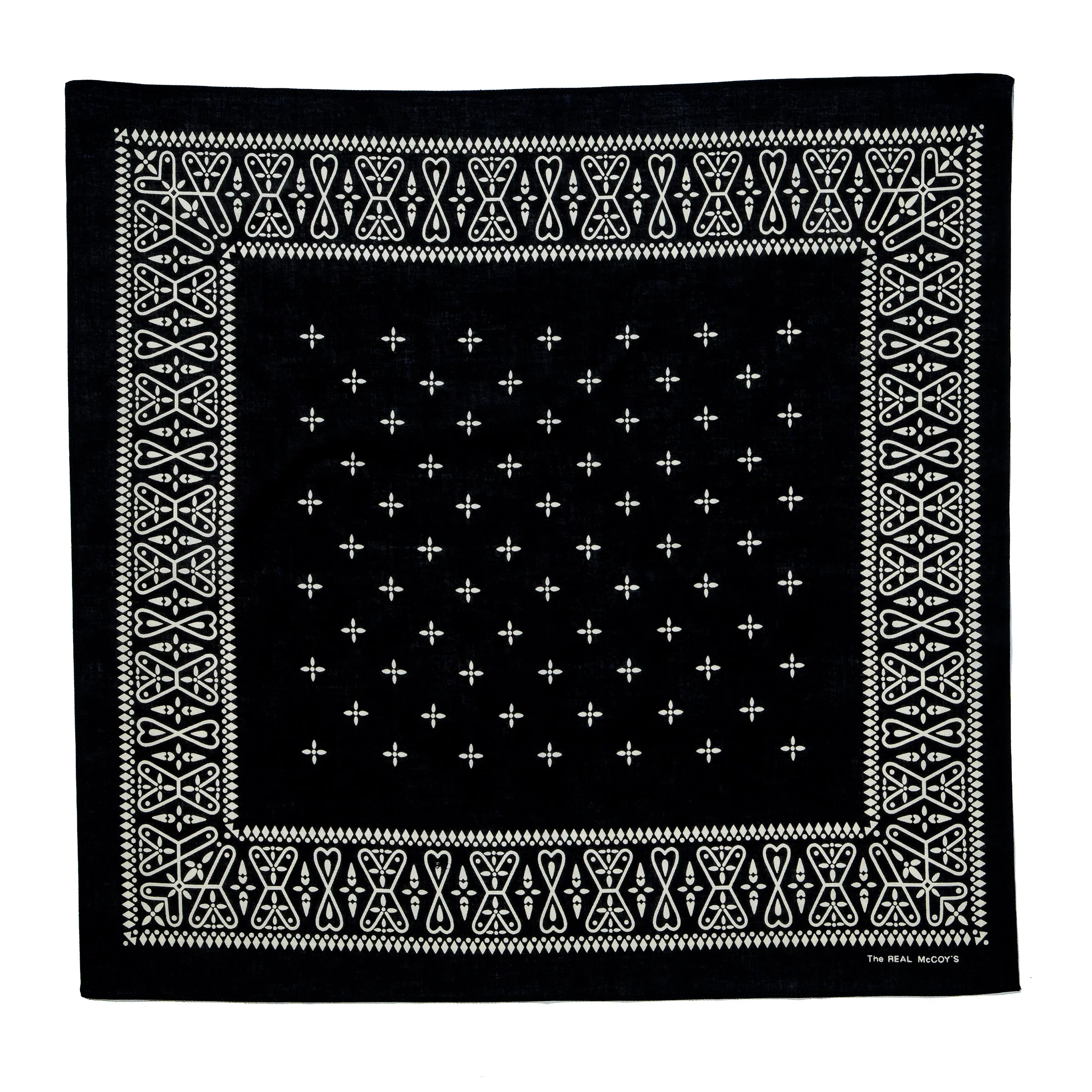
Good for dust, sweat, and honest work, The Real McCoy’s BANDANNA 'CROSS’ is made in Japan from 100% cotton. The traditional cross motif recalls early printed work cloths, valued for their clarity, balance, and ease of use when folded or tied.
The bandanna has its origins in South Asia, where brightly printed cotton cloths were produced using early resist-dye techniques. These textiles were exported widely from the 17th century onward, spreading through trade routes into Europe and, later, North America. The word itself is derived from Indian languages, referring to the act of tying or binding cloth.
By the late 18th and early 19th centuries, printed neckerchiefs and head cloths had become common across working populations. In the United States, bandannas were adopted by farmers, laborers, and frontiersmen for their practicality. They served as protection from dust and sun, sweat absorbers, improvised masks, and general-purpose cloths.
During the 19th century, production shifted increasingly to Western mills, particularly as printing technology improved. Repeating geometric motifs, dots, and simple symbolic patterns became standard, both for ease of manufacture and visual clarity. Such designs allow the cloth to be folded or worn in multiple ways without losing balance or symmetry and can be effective for obscuring marks picked up during rugged use.
In the late 19th and early 20th centuries, bandannas became closely associated with workwear and outdoor labor. They were commonly worn by railroad workers, miners, and cowboys, and later by factory workers and military personnel. During wartime, bandannas were often issued or privately purchased for use in the field, valued for their versatility at a minimal cost.
- 100% Cotton
- Made in Japan
Good for dust, sweat, and honest work, The Real McCoy’s BANDANNA 'CROSS’ is made in Japan from 100% cotton. The traditional cross motif recalls early printed work cloths, valued for their clarity, balance, and ease of use when folded or tied.
The bandanna has its origins in South Asia, where brightly printed cotton cloths were produced using early resist-dye techniques. These textiles were exported widely from the 17th century onward, spreading through trade routes into Europe and, later, North America. The word itself is derived from Indian languages, referring to the act of tying or binding cloth.
By the late 18th and early 19th centuries, printed neckerchiefs and head cloths had become common across working populations. In the United States, bandannas were adopted by farmers, laborers, and frontiersmen for their practicality. They served as protection from dust and sun, sweat absorbers, improvised masks, and general-purpose cloths.
During the 19th century, production shifted increasingly to Western mills, particularly as printing technology improved. Repeating geometric motifs, dots, and simple symbolic patterns became standard, both for ease of manufacture and visual clarity. Such designs allow the cloth to be folded or worn in multiple ways without losing balance or symmetry and can be effective for obscuring marks picked up during rugged use.
In the late 19th and early 20th centuries, bandannas became closely associated with workwear and outdoor labor. They were commonly worn by railroad workers, miners, and cowboys, and later by factory workers and military personnel. During wartime, bandannas were often issued or privately purchased for use in the field, valued for their versatility at a minimal cost.
- 100% Cotton
- Made in Japan
Original: $54.08
-65%$54.08
$18.93Description
Good for dust, sweat, and honest work, The Real McCoy’s BANDANNA 'CROSS’ is made in Japan from 100% cotton. The traditional cross motif recalls early printed work cloths, valued for their clarity, balance, and ease of use when folded or tied.
The bandanna has its origins in South Asia, where brightly printed cotton cloths were produced using early resist-dye techniques. These textiles were exported widely from the 17th century onward, spreading through trade routes into Europe and, later, North America. The word itself is derived from Indian languages, referring to the act of tying or binding cloth.
By the late 18th and early 19th centuries, printed neckerchiefs and head cloths had become common across working populations. In the United States, bandannas were adopted by farmers, laborers, and frontiersmen for their practicality. They served as protection from dust and sun, sweat absorbers, improvised masks, and general-purpose cloths.
During the 19th century, production shifted increasingly to Western mills, particularly as printing technology improved. Repeating geometric motifs, dots, and simple symbolic patterns became standard, both for ease of manufacture and visual clarity. Such designs allow the cloth to be folded or worn in multiple ways without losing balance or symmetry and can be effective for obscuring marks picked up during rugged use.
In the late 19th and early 20th centuries, bandannas became closely associated with workwear and outdoor labor. They were commonly worn by railroad workers, miners, and cowboys, and later by factory workers and military personnel. During wartime, bandannas were often issued or privately purchased for use in the field, valued for their versatility at a minimal cost.
- 100% Cotton
- Made in Japan