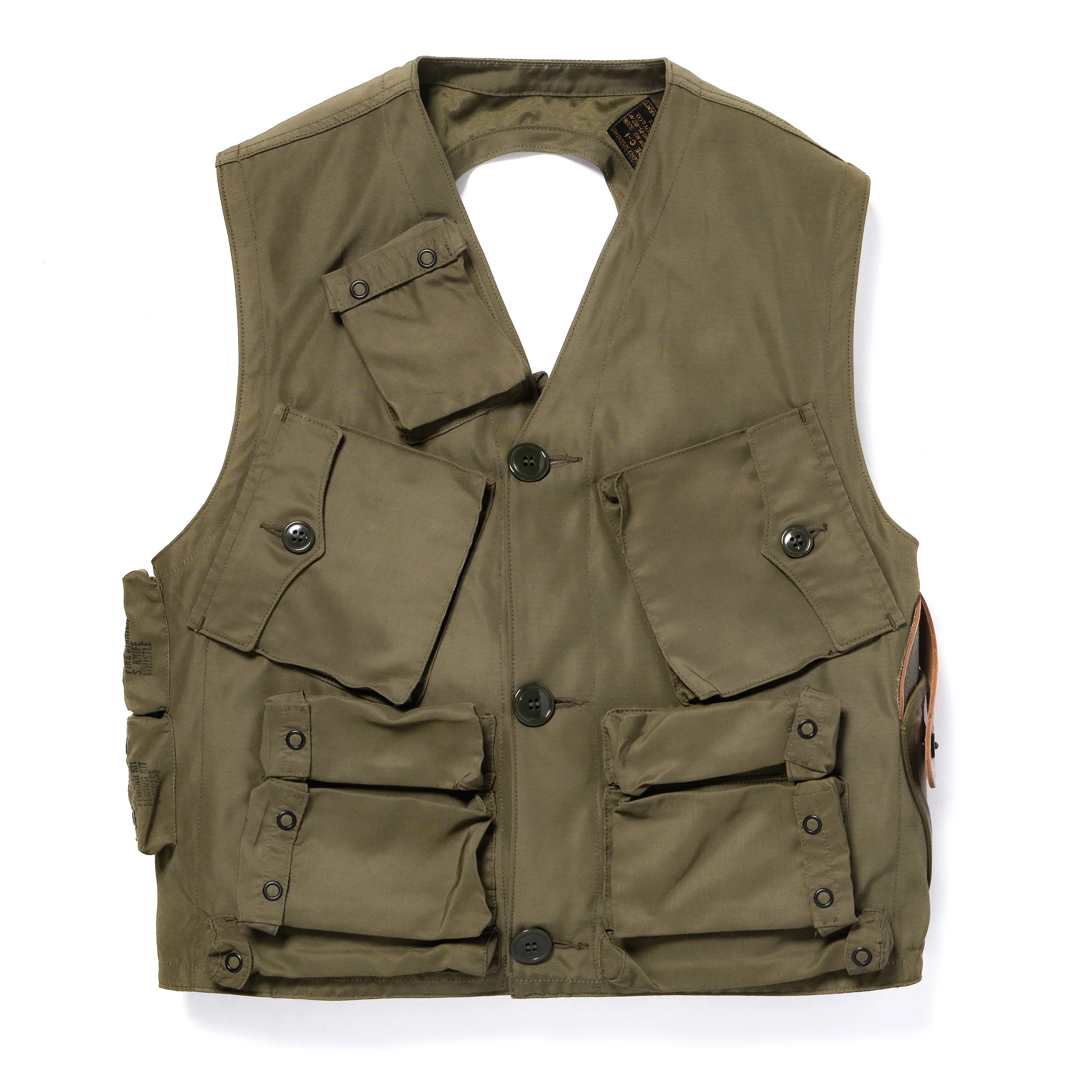
TYPE C-1 VEST, EMERGENCY SUSTENANCE
The TYPE C-1 VEST, EMERGENCY SUSTENANCE was developed by the U.S. Army Air Forces for aircrews operating in the latter stages of World War II. First-pattern examples, distinguished by angled upper chest pockets, were issued predominantly to crews operating in the Pacific theater. The design accommodated a range of survival equipment suited to jungle and open-water emergencies and, though conceived for universal deployment, the vest adapted well to tropical and Arctic environments.
The vest was intended to be worn over the uniform and A-2 leather jacket but beneath the B-7 life preserver, body armor, and parachute harness. In practice, the combined weight of the fully loaded vest proved cumbersome in certain theaters, leading to the development of a supplementary musette bag that could be attached to the parachute harness for bailout, with the vest then equipped following landing.
Three distinct variants of the C-1 are documented: the two earliest feature slant-cut front pockets secured by large urea buttons, while the final production version uses straight, top-opening pockets secured by ring-snap fasteners. All pockets were labeled and numbered externally to identify their intended contents. A leather-reinforced canvas holster on the left side accommodated a standard-issue .45 caliber M1911 pistol. Standard contents varied by deployment region but typically included emergency rations, an ESM-2 signaling mirror, waterproof match case with compass, first aid kit, fishing and sewing kit, insect repellent, signaling flares, a survival manual, and the reversible yellow and olive Type C-1 survival cap, reproduced by The Real McCoy’s as the REVERSIBLE SUN HAT WITH ADJUSTABLE BAND. When fully equipped, the vest weighed approximately 11 pounds.
The TYPE C-1 VEST, EMERGENCY SUSTENANCE is adjustable via tie tapes at the rear and was issued in a single universal size. Production ran from 1944 to 1945; however, existing stock remained in service well beyond the end of the war, seeing continued use through the Korean War and partially into the Vietnam era.
- Cotton Rayon Blend Fabric
- Cotton Sewing Thread Construction
- Four-part fastening: Ring-type snap buttons
- Urea Buttons
- Made in Japan
The TYPE C-1 VEST, EMERGENCY SUSTENANCE was developed by the U.S. Army Air Forces for aircrews operating in the latter stages of World War II. First-pattern examples, distinguished by angled upper chest pockets, were issued predominantly to crews operating in the Pacific theater. The design accommodated a range of survival equipment suited to jungle and open-water emergencies and, though conceived for universal deployment, the vest adapted well to tropical and Arctic environments.
The vest was intended to be worn over the uniform and A-2 leather jacket but beneath the B-7 life preserver, body armor, and parachute harness. In practice, the combined weight of the fully loaded vest proved cumbersome in certain theaters, leading to the development of a supplementary musette bag that could be attached to the parachute harness for bailout, with the vest then equipped following landing.
Three distinct variants of the C-1 are documented: the two earliest feature slant-cut front pockets secured by large urea buttons, while the final production version uses straight, top-opening pockets secured by ring-snap fasteners. All pockets were labeled and numbered externally to identify their intended contents. A leather-reinforced canvas holster on the left side accommodated a standard-issue .45 caliber M1911 pistol. Standard contents varied by deployment region but typically included emergency rations, an ESM-2 signaling mirror, waterproof match case with compass, first aid kit, fishing and sewing kit, insect repellent, signaling flares, a survival manual, and the reversible yellow and olive Type C-1 survival cap, reproduced by The Real McCoy’s as the REVERSIBLE SUN HAT WITH ADJUSTABLE BAND. When fully equipped, the vest weighed approximately 11 pounds.
The TYPE C-1 VEST, EMERGENCY SUSTENANCE is adjustable via tie tapes at the rear and was issued in a single universal size. Production ran from 1944 to 1945; however, existing stock remained in service well beyond the end of the war, seeing continued use through the Korean War and partially into the Vietnam era.
- Cotton Rayon Blend Fabric
- Cotton Sewing Thread Construction
- Four-part fastening: Ring-type snap buttons
- Urea Buttons
- Made in Japan
Description
The TYPE C-1 VEST, EMERGENCY SUSTENANCE was developed by the U.S. Army Air Forces for aircrews operating in the latter stages of World War II. First-pattern examples, distinguished by angled upper chest pockets, were issued predominantly to crews operating in the Pacific theater. The design accommodated a range of survival equipment suited to jungle and open-water emergencies and, though conceived for universal deployment, the vest adapted well to tropical and Arctic environments.
The vest was intended to be worn over the uniform and A-2 leather jacket but beneath the B-7 life preserver, body armor, and parachute harness. In practice, the combined weight of the fully loaded vest proved cumbersome in certain theaters, leading to the development of a supplementary musette bag that could be attached to the parachute harness for bailout, with the vest then equipped following landing.
Three distinct variants of the C-1 are documented: the two earliest feature slant-cut front pockets secured by large urea buttons, while the final production version uses straight, top-opening pockets secured by ring-snap fasteners. All pockets were labeled and numbered externally to identify their intended contents. A leather-reinforced canvas holster on the left side accommodated a standard-issue .45 caliber M1911 pistol. Standard contents varied by deployment region but typically included emergency rations, an ESM-2 signaling mirror, waterproof match case with compass, first aid kit, fishing and sewing kit, insect repellent, signaling flares, a survival manual, and the reversible yellow and olive Type C-1 survival cap, reproduced by The Real McCoy’s as the REVERSIBLE SUN HAT WITH ADJUSTABLE BAND. When fully equipped, the vest weighed approximately 11 pounds.
The TYPE C-1 VEST, EMERGENCY SUSTENANCE is adjustable via tie tapes at the rear and was issued in a single universal size. Production ran from 1944 to 1945; however, existing stock remained in service well beyond the end of the war, seeing continued use through the Korean War and partially into the Vietnam era.
- Cotton Rayon Blend Fabric
- Cotton Sewing Thread Construction
- Four-part fastening: Ring-type snap buttons
- Urea Buttons
- Made in Japan